Blockade
A.k.a. Cul-de-Sac. Beat the barriers.
Blockade
SET UP
A table and 2 chairs.
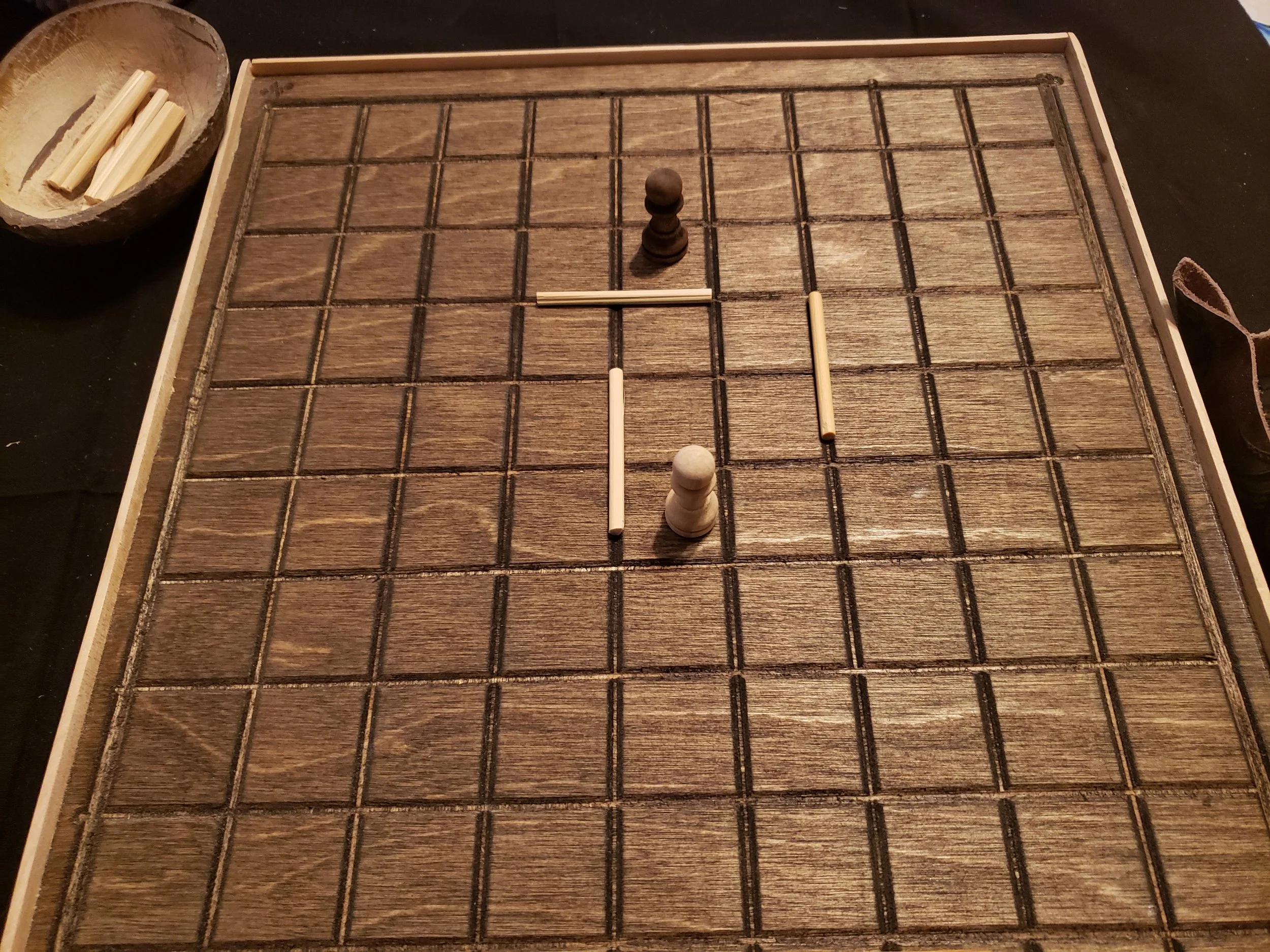
1 square grid board 11x14 , placed lengthwise bewteen the players.
2 pawns of the same color, for each player
2 tokens for each player
9 white double sized sticks for each player
and 9 dark double sized sticks for each player.
in the four corners of the board, a token is placed in any of the 4x4 squares, 2 by each player.
The player's pawns are placed occupying the player's bases.
The players' 9 white and 9 dark, 18 total sticks are made available to each player.
Sequence of play is randomly selected.
Number of Players
2
Objective
The object of the game is for each player to get both of their pawns to the starting locations of their opponent. The first to do so wins.
Rules
On your turn, move one of your pawns either two spaces orthogonally (forward, backward, left, or right) or one space diagonally.
After moving your pawn, you may place one of your wall barriers (blocking two spaces) into an open groove on the board.
Key Rule: You can never completely trap a pawn or block off all paths to a home space; at least one open route must always remain available.
Stick placement is determined by the color,
All white sticks are placed in a vertical direction.
All dark sticks are placed in a horizontal direction.
Player Variations
There are many variations to this simple game.
What if, EITHER pawn must occupy an enemy base?
or what if, instead and move AND place a wall, its move OR place a new wall?
What if, your stick inventory was limited to 7 of each color?
or what if the board size changed?
History
Blockade is an old school game designed by Philip Slater in 1975
Game Theory / Game Dynamics
This game is amazingly simple once the rules are known and it proudly resides in the Abstract Avalanche, the Sticks and Stones Series, the Predators Tract, and the Head Games shelves of my game room.
Once the basic game is played, you will find yourself wanting to try a variation on your next attempt.
For strategy, think in terms of not blocking your own path. Its best to leave a maze of confusion behind you.
But don’t get too elaborate in setting your trap, an opponents next wall placement can sabotage your plan.
And the length of the board matters.
Keep inventory of your remaining sticks, it is easy to run out.
Be thoughtful of your wall placements, as Karma has a way of affecting your route too.
I hope you enjoy playing games,
as much as I have making them.
Thank you for visiting