mastermind
Decipher a hidden code in a puzzle of logic and deduction.
MAsterminds
SET UP
3 4x4 modular square grid boards
1 eye shield.
A set of 3 spike holder boards.
6 full sets of different colored stones.
A full set of spikes, in 2 different colors, light and dark.
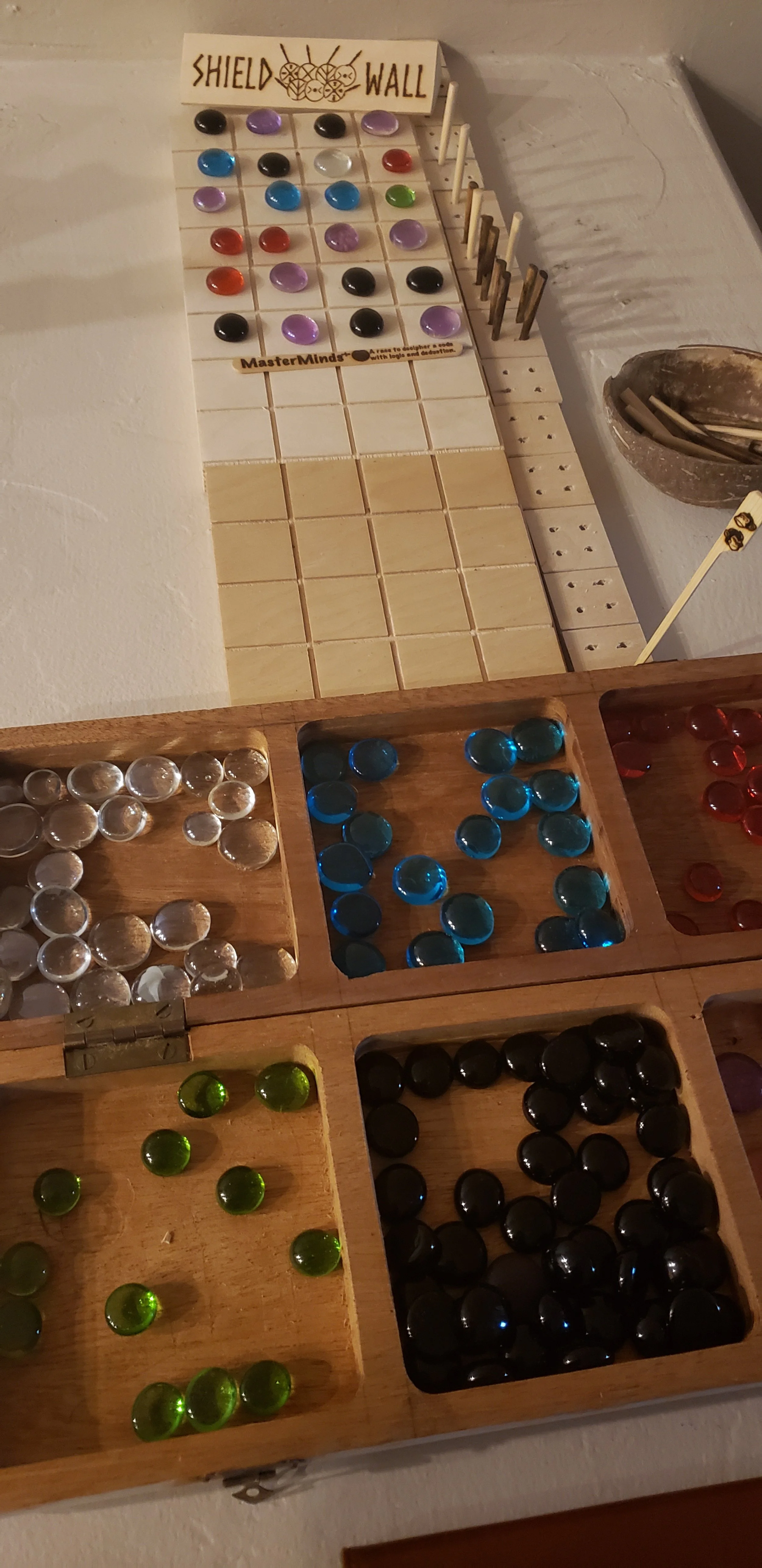
The game is set with the board set up in a 4x12 grid configuration, and an eye shield protecting the visibility of the row closest to the player, so that the opposing player or team cannot see the last row.
The spike holders are set up along side one edge of the now 4x11 board of each player.
The spikes and the assortment of 6 different colored stones are placed in a shared space available to both players.
Number of Players
2, with asymmetrical objectives. One is the code maker, the other is the code breaker.
Objective
To decipher the Code Maker’s hidden code .
Rules
To start, the Code maker player will hide any 4 colored stones behind their shield wall is which no more than 2 can be of the same color.
On the first round, the Code breaker player will assemble 4 stones in an attempt to guess the other players solution. Once committed to their entry, scoring can ensue.
For each stone committed, the Code maker provide a stake to identify its condition.
For a stone that is of the right color, but in the wrong position, place a light colored stake aligned to that row.
For a stone that is of the right color and in the right position, place a dark colored stake aligned to that row.
For a stone that is not the right color or position, no stake is provided.
Stake placements are random, they do not align to the order of the committed stones in sequence.
Player Variations
Mastermind is played with 6 color variations, an could always be expanded to include more colors, or allow blank spaces.
2 players, with a competitive option. Played twice, where each player takes the challenge of code breaker. The player that deciphered the code in the fewest number of attempts wins.
You could also play multiple rounds and play for points. For example, if one player is able to solve the code in 5 tries, and the opposing player on their turn as the code breaker, solves it in 8 tries, the winner would earn the difference of 3 points on a scorecard for the round. Played for a total cumulative high score of X.
History
Mastermind, Master Mind, is an old school classic created by Mordecai Meirowitz, an Isreali Intelligence Officer working in the ciphers and communications department, in 1970. He eventually sold his idea for a game to Hasbro, which has successfully sold this game for the last 50 years. In the 2 player game, each player has a separate role- the code maker, OR the code breaker.
For a competitive variation, check out Masterminds, my pluralized version.
Game Theory / Game Dynamics
If you enjoy logic and deduction challenges, this game is for you.
This game only works if the code maker provides the correct stakes and count as the clues. A miscalculation will mislead the code breaker with an unsolvable dilemma. If a round is determined to be miscalculated, the code maker automatically loses the round.
This game is a real puzzler, and a favorite of my hero, Wiley Coyote, in that you have to try something, fail, learn from it, adapt and try again. Then rinse and repeat until you finally catch that bird.
Recommendation: start with two colors in your first attempt. Depending on your clues received, you can begin to apply logic to start deducing how they line up for your next attempt.
If you receive no stakes as your clue, don’t be discouraged, that is a good thing! You have just eliminated those color options from the solution.
Trust your gut. Push your logical thinking on each attempt until proven wrong. Then pause and reflect to re-evaluate.
‘Awaken a New Master’…
I hope you enjoy playing games,
as much as I have making them.
Thank you for visiting