Shōbu
A modern marvel classic that is ‘beautifully challenging’.
Shōbu
A passive aggressive shoving match with mirrored reflections.
SET UP
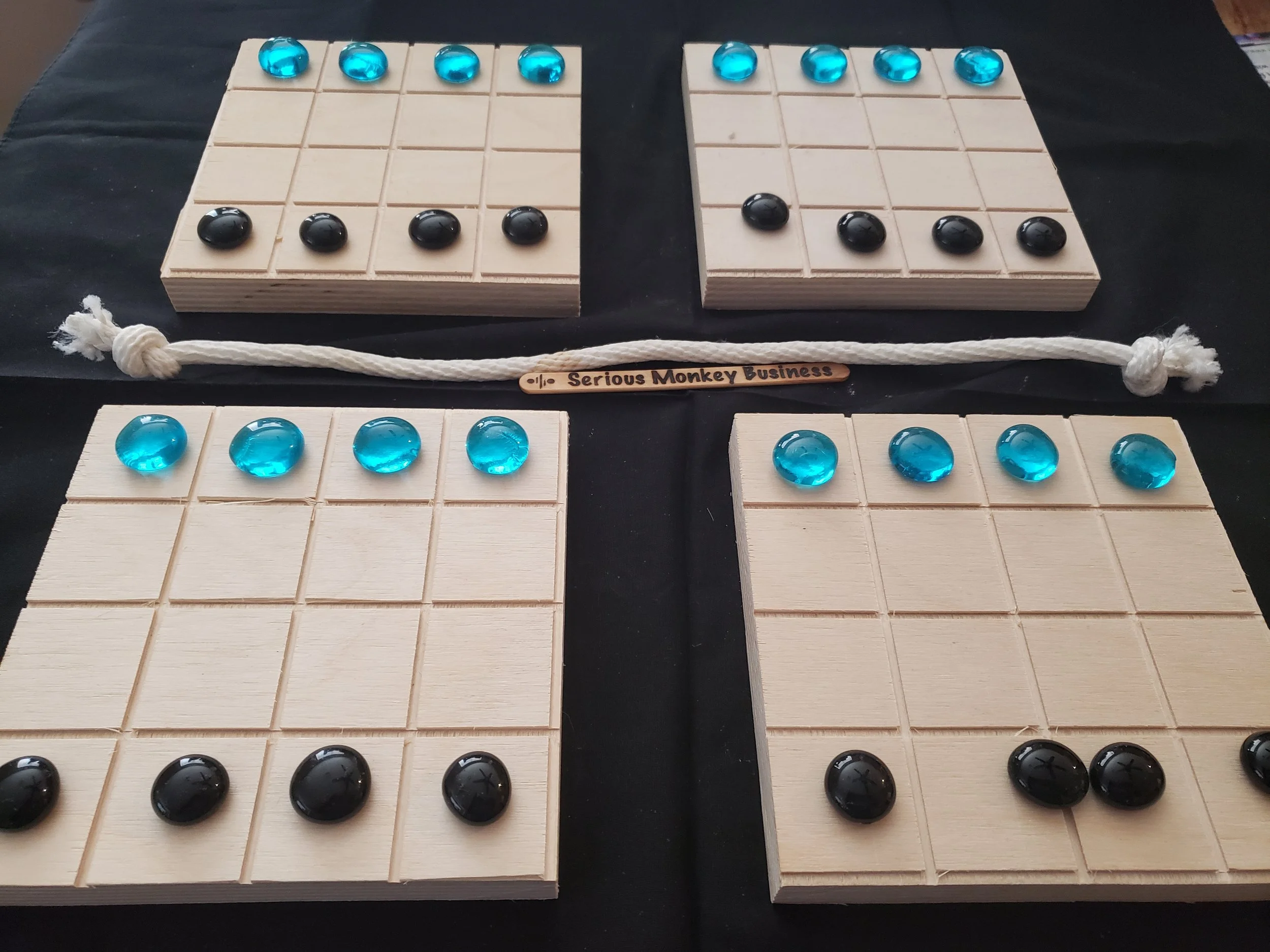
Place four 4x4 modular boards arranged in a square pattern with space between them.
Each board has 8 stones (4 stones of each color), for a total of 16 of each color.
4 stones are preset on the back line of each board in uniform.
A piece of rope, or ‘a line in the sand’ separate two boards for each player.
Boards are paired: each player controls the two boards closest to them.
Number of Players
2
Objective
Push all of your opponent’s stones off any one board to win.
Stones are never captured; they are pushed off the edge.
Rules
On your turn, you make two moves:
A passive move: move one of your stones one or two spaces in any direction (orthogonally - adjacently or diagonally) on any board.
An aggressive move: mirrors one of your stones the same number of spaces in the same direction on another board.
Aggressive moves can push opponent stones if your stone moves into their space, provided there is an empty space behind them.
You cannot push more than one stone at a time.
Stones cannot jump over others.
The game ends when a player pushes all opponent stones off a single board.
Player Variations
A variation could start with the stones preset in the middle row or each board.
History
Shōbu is a modern abstract strategy game, designed by Manolis Vranas and published in 2019.
Inspired by traditional games like Go and Chess but with a minimalist, tactile design.
Known for its elegant simplicity and deep strategic play, it is perfectly described as ‘ beautifully challenging’.
Game Theory / Game Dynamics
Hats off to Manolis Vranas for coming up with this modern masterpiece!
This game exemplifies the simple, but deep strategic thinking, needed to win.
The challenge of passive aggressive mirrored reflection movements make this game very deep. You need to plan your moves in pairs.
Here are some suggested strategies to play…
Control the Center
Stones in the center of each board have more flexibility for movement.
Central positions give you more options for both passive and aggressive moves.
Balance Your Boards
Don’t focus only on one board—winning requires pushing all opponent stones off any one board, but neglecting others makes you vulnerable.
Spread your influence across all four boards.
Use Passive Moves Wisely
Passive moves are defensive: strengthen your positions and prepare for aggressive pushes.
Avoid wasting passive moves on isolated stones unless necessary.
Plan Aggressive Moves
Aggressive moves can push opponent stones off the board, but only if there’s space behind them.
Look for opportunities where a single push creates a chain reaction of threats.
Create Pressure
Force your opponent into defensive moves by threatening multiple boards at once.
If they respond on one board, you can exploit weaknesses on another.
Avoid Overextension
Don’t push too far forward without support—isolated stones are easy to counter.
Keep stones connected for flexibility.
Think Two Moves Ahead
Every turn has two moves (passive + aggressive). Plan them as a pair.
Use passive moves to set up aggressive pushes in the same direction.
I hope you enjoy playing games,
as much as I have making them.
Thank you for visiting