Tic Tac Toe
An ancient lesson on strong positioning, and a prime example for describing the One VISION mindset.
Tic Tac Toe
Get 3 in a row to win.
SET UP
Paper and pencil, or
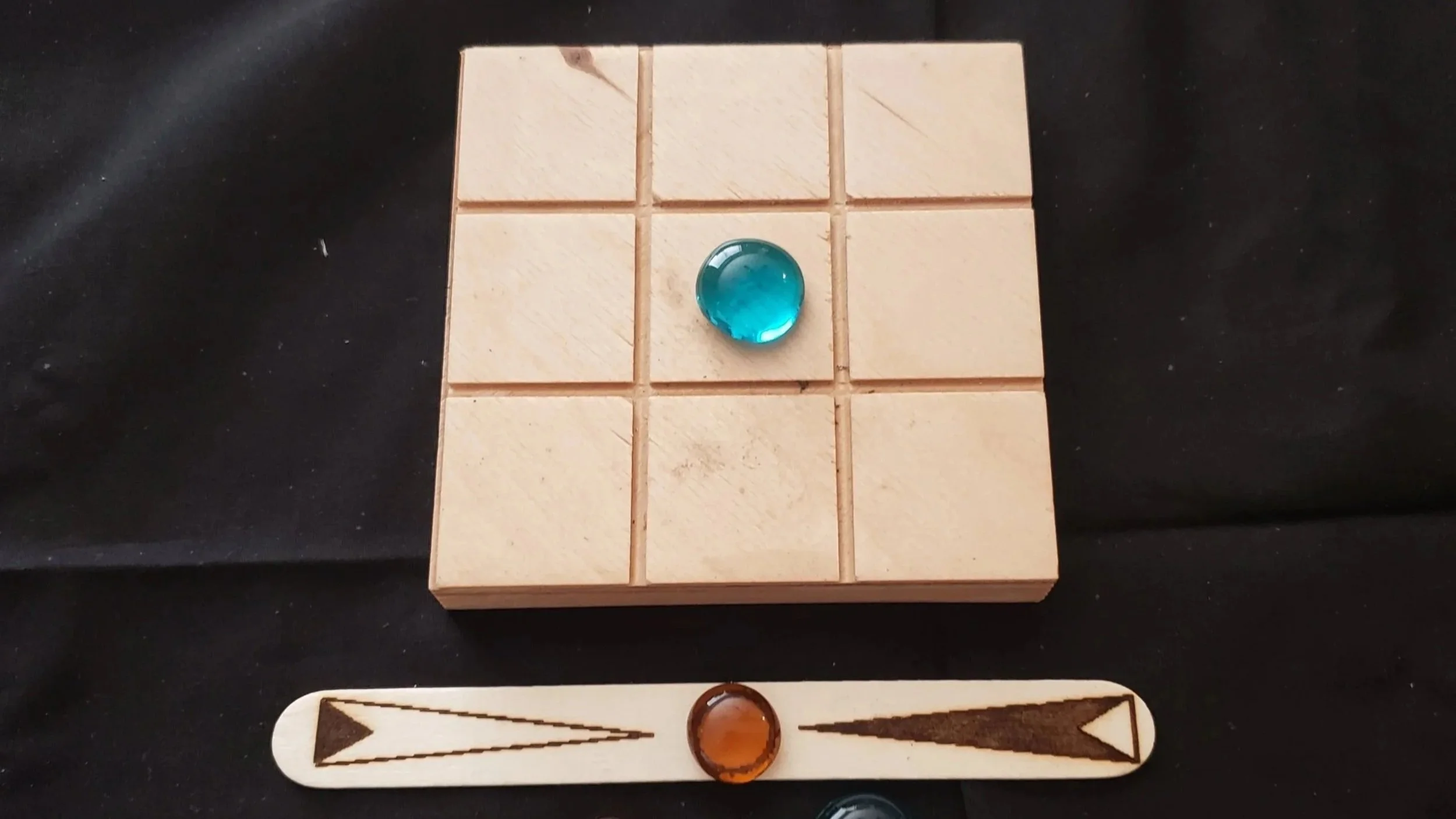
1 x 3x3 modular square grid board
a handful of 2 different colored stones.
The game starts on an open field.
Random draw determines which player has the opening move.
Players take alternating turns to place a pawn.
Number of Players
2
Objective
To be the first player to complete 3 stones in a row.
Rules
On your turn, place a stone on any open cell on the grid.
Pawns do not move once placed.
The player to create a linear line of 3 stones in a row wins.
Player Variations
Tic Tac Toe is played as a 2 player game.
Other variations include 3 Mans Morris , and Terni Lapilli with diagonal movements.
Check our Bamogo for a multiplayer option of Tic Tac Toe, played for points.
Or try Toe -Tac-Tic for a bizarro reverse variant in strategy, try NOT to get 3 in a row. Who wants to go first now?
History
Tic Tac Toe dates back to 1300 BC. with the earliest known versions played in Egypt. This game migrated to the Roman Empire and and eventually to Great Britain before spreading to the rest of the world.
A.k.a. “Tick-Tack”, “Naughts and Crosses”, or “‘X’s and ‘O’s” . This game has been an elementary favorite for centuries, and for good reason, it teaches the basics skills to play most any game.
Game Theory / Game Dynamics
Before you scroll away and roll your eyes, I’ll ask you to take your game play a little more seriously. I will unlock the secret sauce of all games if you follow along with how to play this game properly.
The arena. If you play Tic-Tac-Toe with pencil and paper, don’t just draw the hashtag symbol (#), also include the 4 lines to outline the borders. Now consider what you really have here, a beautiful 3x3 square grid. A grid with only 9 available spaces. And a grid that could be used for any number of 4x4 games if you played on the intersections. Actually for Tic-Tac-Toe, all you need is a smaller 2x2 grid. The first insight is the flexibility of a grid pattern to adjust to multiple sizes to fit which ever game you wish to play.
Next comes the pawns. Whether they are drawn on with X’s and O’s, or you can use nearly any type of physical objects. You could use sea shells, nuts, coins, corks, stones, bottle caps, wooden figurines, etc. Anything can serve as a game piece, so long as the pawns are in uniform.
For a game to start, a determination is needed to declare which player will move first, which is a huge advantage in this particular game. Random selection is suggested, by a flip of a coin, or other mystical means. Or you could have a traditional custom, such as the youngest or the oldest player has the honor of first move. It could also be a house rule, seating position, or any other factor.
Once the order is determined, the game can start.
The unwritten ‘rule’ of Tic-Tac-Toe is the first player’s move is always in the center space. Why?
Because of all the possibilities, the center space is the only one that can participate in a winning condition 4 different ways. A corner space could participate 3 ways, and a side space can only participate in 2 possible winning conditions. By taking the center space, you also remove 4 possible winning conditions of your opponent.
Because the center space is the only one that cannot be mimicked. ( a common defensive play is to mirror your opponent’s moves.) In this game, there is only one center space and not enough room to maneuver effectively. The limitation of the board size prevents it.
and because, to move anywhere else on the board is Defeatus. Allowing your opponent to take the center space will give up this huge advantage and only work against you. Which brings us to the first Ethos of a good game player’s mindset. Play with CORE INTENT, in other words -if you are going to play a game, play to win, or don’t play at all.
Now the game really begins, with the second player’s opening move, and they really only have 2 choices- a side space or a corner. A side space is left with only one possibility to participate in a winning condition, whereas a corner space has two. Its the second player’s chance to decide if they really want to play a game or not, remember playing with CORE INTENT is one of the keys.
The first player’s second move introduces the other key ingredient. Always play games with ETIQUETTE, by announcing your threats. In a game where only 3 in a row wins, creating two in a row is a serious threat and the first player should provide fair warning by saying, ‘Two’ or ‘Tack’, or ‘Check’. No one wants to win a game by accident.
When played properly with the right mindset, you will never lose a game of Tic-Tac-Toe. It should always end in a tie. You might not win, but you will never lose.
The most valuable lesson here is, play all games with CORE INTENT and ETIQUETTE. Play with honor, courtesy and respect and you will always win. Respect for the spirit of the game itself and respect for your opponent. Express gratitude for sharing in the experience of playing a game together. Even if you did lose, there are lessons to be learned to improve your next attempted game.
If everyone understood and played games with the right mindset, it opens the possibilities to change the world.
I hope you enjoy playing games,
as much as I have making them.

Thank you for visiting