Gomoku
5 in a row wins.
An ancient game of the Samurai. A game of honor and respect.
GoMoku
SET UP
Paper and pencil, or
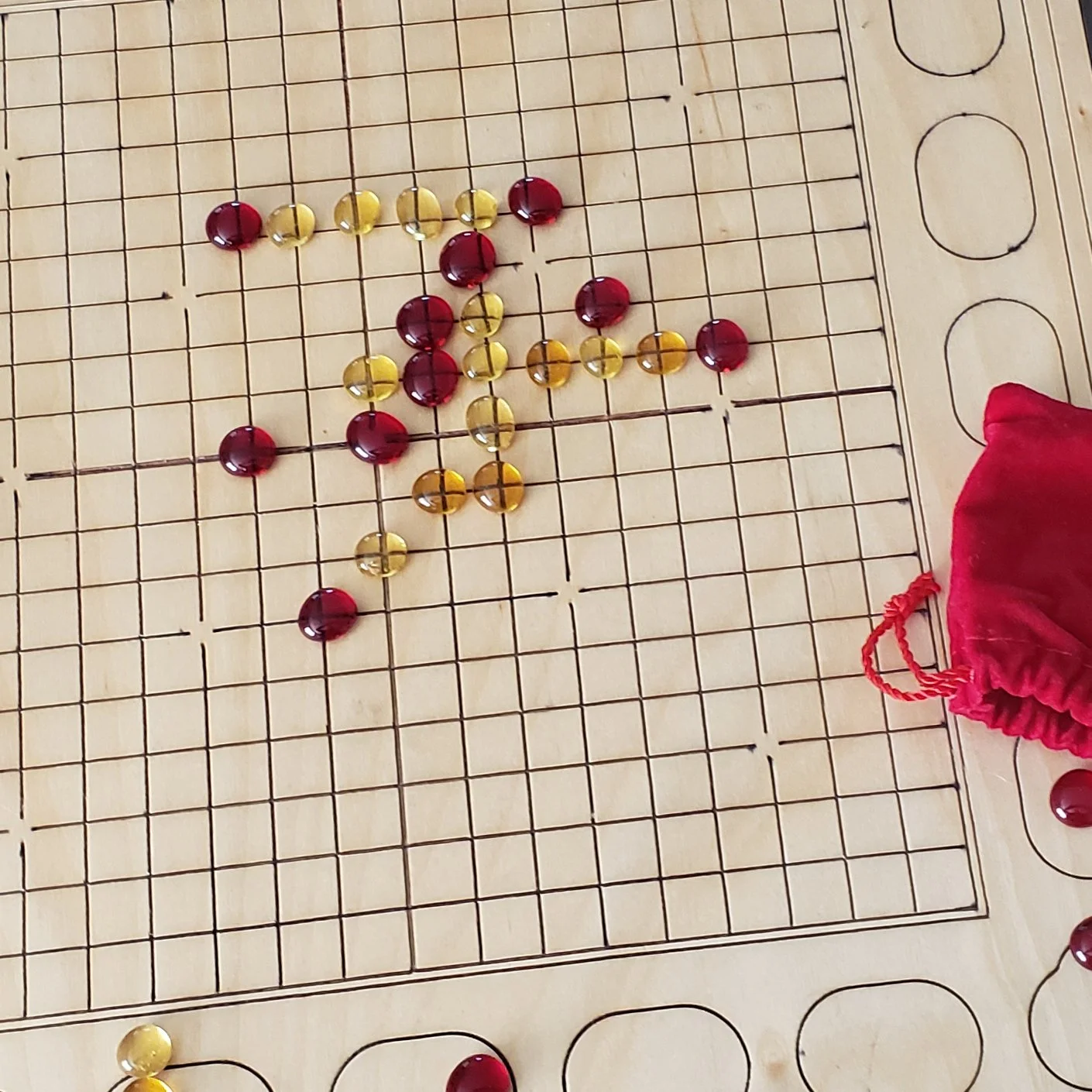
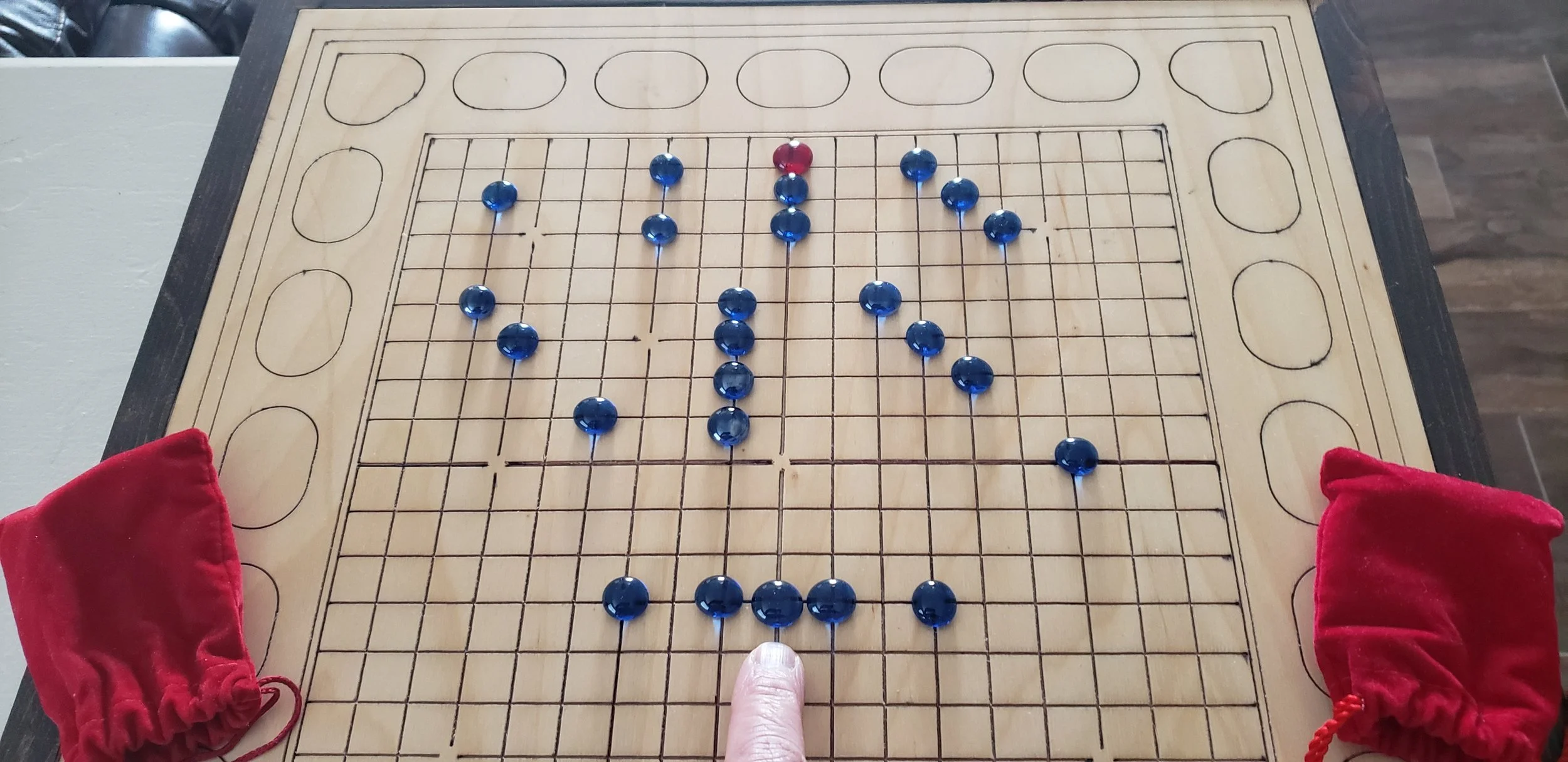
1 x 15x15 modular square grid board
2 x sets of different colored stones.
The game starts on an open field.
Random draw determines which player has the opening move in the center.
Game play moves clockwise.
Number of Players
2
Objective
To be the first player to complete 5 stones in a row, horizontally, vertically, or diagonally.
The line must be exactly 5 stones in an un-interrupted row.
Rules
First move always starts in the center intersection.
On your turn, place a stone on any open intersection on the grid.
Players take alternating turns until one player completes 5 in a row - horizontally, vertically, or diagonally.
A line of 6 or more stones does not win.
Player Variations
GoMoku is traditionally played on a 15 x15 Goban, but historically played on a full size 19x19 Goban.
Freestyle GoMoku allows for a line of any size 5 or more to win.
In the Swap after 1st Move GoMoku variation, after the first player places the opening stone in the center, this version allows the second player a choice to switch colors.
History
GoMoku is an ancient game originating from the Orient.
Along with Go, and Renju, it is believed to be a favorite game of the Samurai in the feudal Japan era, for its game play requiring honor and respect.
Game Theory / Game Dynamics
This is a favorite of mine to introduce children to the next level of strategy games.
If you have ever played Tic-Tac-Toe with a child, introduce them to this game for a quantum leap in cognitive thinking.
This game is also one of strong positioning. It can also be played with pencil and paper and a straight edge ruler.
In Tic-tac-toe, obtaining 3 in a row is limited by the borders, blocks must happen within the line of 3. Without the small board restriction in GoMoku, an open ended 3 in a row is a valid threat, and must be blocked at one end. If not, the line of 3 can quickly becomes a line of 4, and then it is too late to block both sides.
Like all games, play with CORE INTENT and ETIQUETTE. Etiquette is key to announce your threats of ‘three’ and ‘fours’. Lines of 3s and 4s can be stones in a solid (un-interrupted) line, or split in a line that could potentially become 5 in a row.
As you play, ask your child to think out load. Have fun and watch how quickly a young mind learns to develop strategies. You will be enlightened to find they have a lot to teach you too.
‘Awaken a New Master’…
I hope you enjoy playing games,
as much as I have making them.
Thank you for visiting