Renju
An ancient game of the Samurai. A game of honor and respect.
5 in a row or 5 captures, with opening fighting stances.
Renju
An ancient game of the Samurai. A game of honor and respect.
SET UP
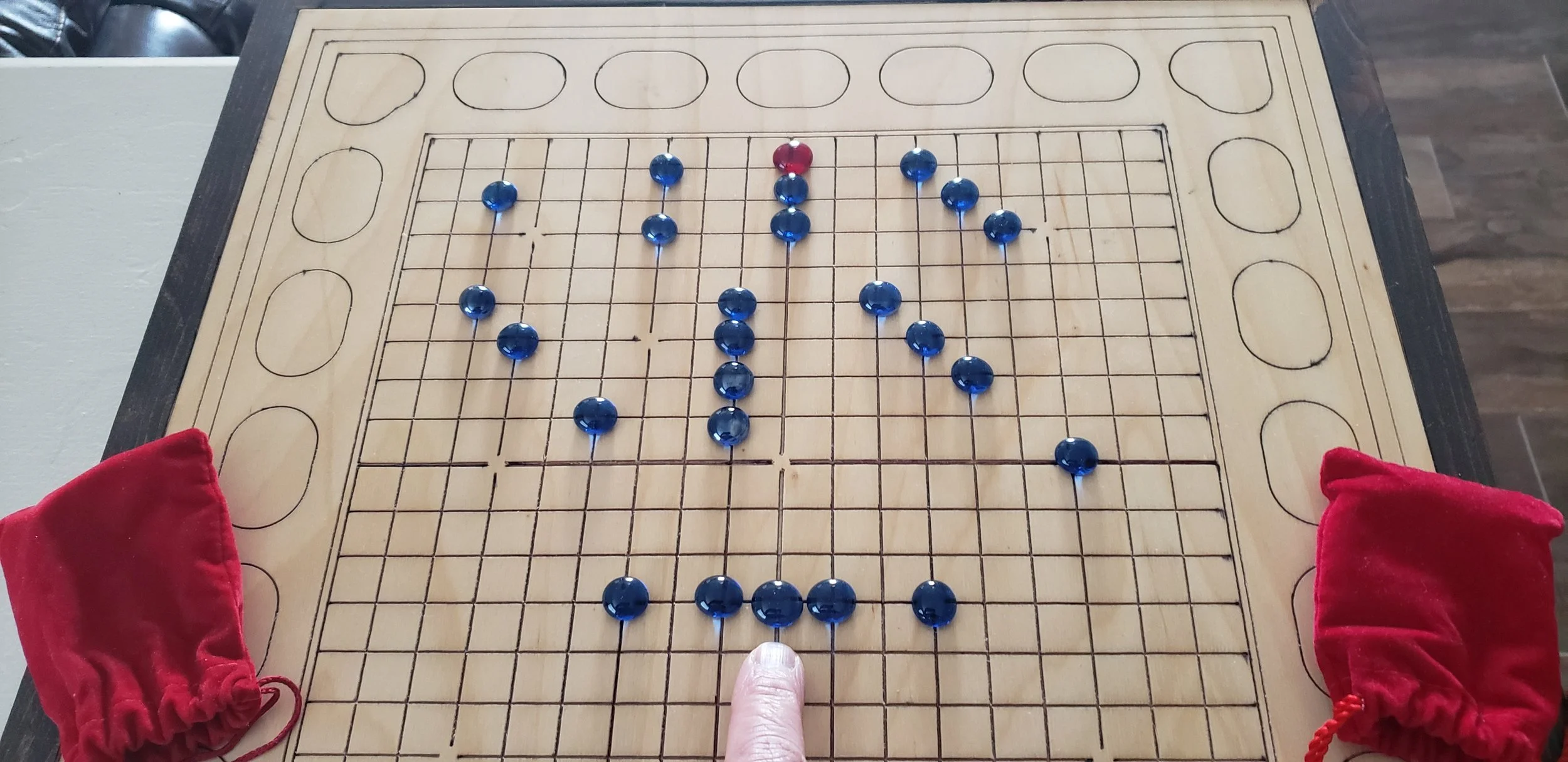
1 x 19x19 Goban square grid board
2 x sets of different colored stones.
The game starts on an open field.
Random draw determines which player has the opening move in the center.
Players take alternating turns placing stones.
Number of Players
2
Objective
To be the first player to complete 5 stones in a row or capture 10 opponent stones.
A line of 5 must be exactly 5 stones in an un-interrupted row. 6 or more in a row does not win.
Rules
The first player is randomly selected.
On the First player’s opening move, they place 3 stones. The first stone always starts in the center intersection, the second stone placed is an opponent’s stone. The third stone placed (same color as the first) can be placed at any open intersection, as long as it is at least 3 spaces away from the center stone.
The second player’s opening move has 3 options.
They can decide to play as the second player and place their second stone anywhere on the board, and play continues.
Or they can decide to be the first player, forfeit their turn, and allow the opponent to play as the second, and play continues.
Or they can place 2 more stones, one of each color, anywhere on the board , and allow the first player the final option.
If the third option is selected, the first player can decide which color to be.
With the open fighting stances determined, play continues with alternating turns.
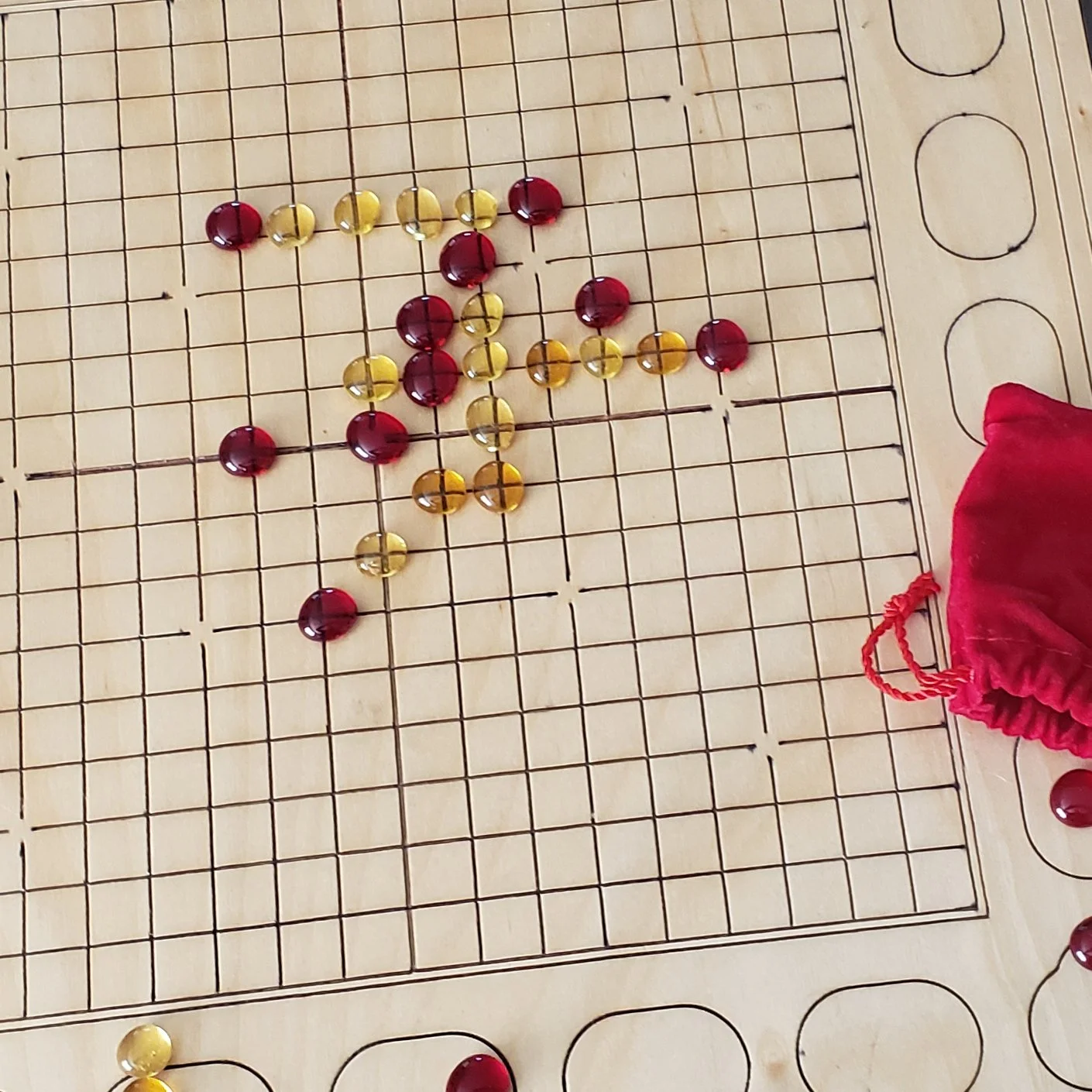
A capture can be made by enclosing a pair within a pair. It must be exactly two adjacent stones encased between 2 opposing stones. For example, if X00_ is on the board, a placement of X00X would effectively remove the inner pair, leaving X_ _ X. A player may voluntarily move into an encased pair position with no penalty. It is the outside stone placement that validates a capture. The 2 captured stones are removed from the board , and left visible on the outside edge. 5 sets of captured stones is an alternative way to win.
Player Variations
Renju is played on a full size 15×15 square grid, but I like to play on a full sized 19×19 Goban board.
There are several variations of Renju allowing for a line of any size of 5 or more to win, playing for points, and/or allowing or forbidding a double 3 or 4 threat.
If playing for points, at the end of the round, 5 points is awarded to the player that makes 5 in a row. 1 point for each captured set, and 1 point for each solid four in a row left intact on the board ( this constitutes a solid threat was made in the round). Play continues with a new round until one player reaches a cumulative total of 21 points.
History
Renju is an ancient game originating from the Orient.
Along with Go, and GoMoku, it is believed to be a favorite game of the Samurai in the feudal Japan era, for its game play requiring honor and respect.
Game Theory / Game Dynamics
Ninuki Renju as these rules describe, played for points, is my absolute favorite strategy game. I think it takes some experience playing other abstracts on a likewise similar board, but well worth the journey to play this masterpiece.
CORE INTENT and ETIQUETTE are key to play this game. Announcing your threats is not only a courtesy, it is a sign of respect. Respect for the spirit of the game and respect for your opposing player. No one wants to win or lose by accident. I like to think the Samurai held their opponents accountable to play with honor or it was off with their heads.
The first three stones played by each player constitute your opening fighting stance. Consider how you are positioned to strike, and your opponent’s position to counter.
The player to make the first 3 in row should strive to keep the initiative, by making additional threats, capturing key blockers, or making ends meet.
To see this game played well is a thing of beauty. It is wise to pause and reflect at the end of each round to ponder the moves made, learn from mistakes and collect new lessons learned. This game is truly an education in itself. Linked here are just some of the ever growing life lessons that I have learned playing classics like Renju.
With the point system, never abandon the game, honor can be found in the surrendering player’s final move.
Part of my diabolical plan is to teach others this game to find another worthy competitive counterpart. It is that good, and I am always looking to play this one.
If you want to take the journey, start with Tic-tac-toe, GoMoku, Pente, and GO.
I hope you enjoy playing games,
as much as I have making them.
Thank you for visiting